
Tidio works well for small businesses that want live chat and a simple AI agent. As volume grows, other questions take over: what the bill looks like at 1,000 conversations a month, which channels you need to cover, and whether the AI can act on a request or only answer it.
Some teams move to a full helpdesk such as Gorgias, Zendesk or Freshdesk. Others keep the tools they have and add an AI agent that changes orders, processes refunds and books appointments in them, across chat, social, email and voice. Cevanos, which publishes this guide, is built for the second group. Prices below come from each vendor's pricing page, read on 24 November 2026.
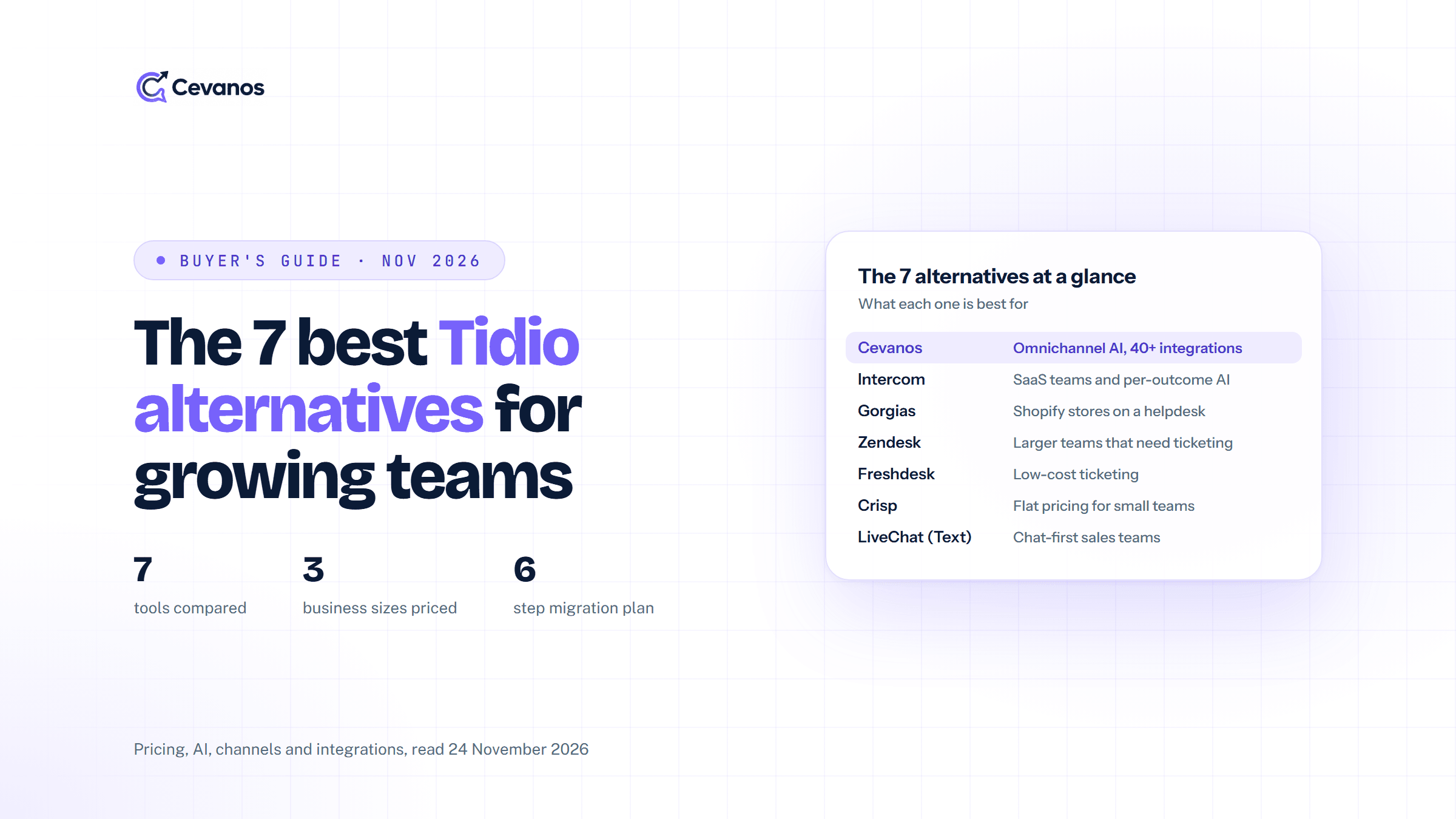
The 7 best Tidio alternatives at a glance
All prices are list prices on monthly billing, in US dollars. Annual billing is cheaper for every tool here.
| Tool | Best for | Paid plans from | How AI is priced | Free plan or trial |
|---|---|---|---|---|
| Tidio (for reference) | Small stores starting with chat and AI | $39 a month with Lyro AI (50 conversations); $29 human-only | Lyro shares one conversation quota with your team | Free plan; 7-day trial |
| Cevanos | An AI agent across chat, social, email and voice that connects to 40+ tools, including Shopify, WooCommerce, Zendesk and Freshdesk | $39 a month (Hobby), per workspace | Monthly credits included: 1,000, 4,500 or 18,000 | Free plan to test the agent; free trial on paid plans |
| Intercom | SaaS teams that want a mature inbox and the Fin AI agent | $39 per seat (Essential); $29 for new customers | Fin: $0.99 per outcome | 14-day trial |
| Gorgias | Shopify stores that need an ecommerce helpdesk | $10 a month (50 tickets); $60 for 300 tickets | About $1.00 per automated interaction | 7-day trial |
| Zendesk | Larger teams that need enterprise ticketing | $25 per agent (Support Team); $69 (Suite Team) | 5 to 10 automated resolutions per agent included, then $2.00 each | 14-day trial |
| Freshdesk | Growing teams that want low-cost ticketing | $23 per agent; $35 for Omni with chat and WhatsApp | Freddy AI Agent: 500 sessions free once, then $49 per 100 | 14-day trial |
| Crisp | Small teams that want flat pricing and many channels | $45 a month (Mini, 4 seats) | AI credits included, roughly 90 to 1,350 automated conversations | Free plan; 14-day trial |
| LiveChat (Text) | Chat-first sales and support teams | $25 per user (Essential) | 10 or 200 AI resolutions included; 50 more for $49.50 | 14-day trial |
Why are businesses looking for Tidio alternatives?
Tidio receives strong ratings on Shopify and G2: 4.8 stars from 1,361 reviews on the Shopify App Store and 4.6 on G2's summary page. Reviewers often mention how quickly they got it running and how easily Lyro learned their product catalogue. Trustpilot is cooler, at 3.5 from 225 reviews, and the low-star reviews repeat a few complaints.
Cost comes up most. Tidio prices by conversations: with Lyro AI on, the Growth plan runs from $75 a month for 100 conversations to $700 for 1,000, and Flows, branding removal, a help center, Inbox AI and phone calls are separate add-ons. One South African business warned that full functionality would cost around "$300 pm not $59 as advertised". Tidio can also upgrade a plan automatically when you reach 95% of the quota. A German store complained that the plan moves up when numbers rise and stays there unless you downgrade by hand; Tidio replied that automatic upgrades are optional and can be switched off.
One review points to a different problem: an AI that trusts an incorrect order status. A US print shop lost a customer, and a custom order worth over $400, after the customer was told the order had arrived. In its public reply, Tidio said Lyro had reported what Shopify showed, delivered to the right address, while the parcel had actually gone elsewhere. The AI repeated the store's record faithfully; the record was wrong. An agent that can also read the carrier's tracking has a chance to notice when the two disagree.
Tidio's plan limits can also become restrictive as teams grow. Its self-serve plans stop at 10 seats and 1,000 conversations a month, beyond which the Plus plan starts at $300 a month plus usage. Lyro can use 3, 5 or 10 Smart Actions depending on plan, and each plan covers a single project; running several needs Plus.
Other low-star Shopify reviews are about billing and support. A French store says it was charged twice and could only reach automated replies while disputing it, and another business found plans and billable conversations described differently on the Shopify App Store and on Tidio's own website.
If none of this applies to you, staying on Tidio is often the cheapest option. Switching takes time, and Tidio does the basics well.
How we evaluated these alternatives
We compared each tool on six things that matter when a team outgrows Tidio:
- What the AI can do: answer from your content only, or also look up and change orders, bookings and accounts.
- Channels: website chat, email, WhatsApp, social and phone, and whether the AI works on each.
- How the bill grows: per seat, per conversation, per resolution or a flat plan.
- Integrations: Shopify and other stores, helpdesks, CRMs and payment tools.
- Handoff: how a conversation reaches a person, and what they see when it does.
- Migration effort: how much of a Tidio setup has to be rebuilt.
Prices and plan limits come from each vendor's pricing page on 24 November 2026. Review themes come from the Shopify App Store, Trustpilot and G2's public summary, and the reviews quoted are linked. We didn't run paid trials of every tool, so check the details that matter to you in each vendor's trial.
7 best Tidio alternatives
1. Cevanos: best for an AI agent connected to your channels and tools
Cevanos is an AI customer service and experience platform. One agent works across website chat, WhatsApp, Instagram, Messenger, email and voice, and connects to 40+ tools: stores such as Shopify, WooCommerce and BigCommerce, helpdesks such as Zendesk, Freshdesk, Gorgias and Intercom, CRMs such as HubSpot and Salesforce, and Stripe, AfterShip, Calendly and custom APIs. It learns from your website, help center and documents. Beyond answering, it can look up an order and its tracking, change a shipping address, cancel an unfulfilled order, refund within a rule you write in plain English, send a checkout link or book an appointment. When a person is needed, the conversation moves to the Cevanos Inbox with the history and the reason attached.
The helpdesk connections matter on a list like this one. Cevanos doesn't ask you to give up Zendesk, Freshdesk, Gorgias or Intercom: it can open, reply to, close and reopen tickets or conversations there from the chats it handles, so your team keeps working in the helpdesk it knows.
For a Tidio user, the biggest difference is the pricing model. Plans include a monthly allowance of credits rather than a conversation quota, and a flat price per workspace rather than per conversation. Each agent can use 6, 11 or 18 AI actions, depending on plan.
Pricing: free plan; Hobby $39 a month, Standard $139, Pro $449 (or $29, $104 and $337 billed yearly), with 1,000, 4,500 and 18,000 credits.
Watch out for: fewer team seats than Tidio (2, 4 or 6). Hobby includes Shopify; helpdesk, CRM and Stripe integrations, voice and approval queues start on Standard. The free plan shows what the agent would have done with your questions but doesn't answer customers, and there's no Magento connector. Credits are counted per AI model request, so long conversations and larger models use more. Teams that want tighter control can switch on optional governance: plain-English policies, approval limits and an audit trail.
2. Intercom: best for SaaS teams that want per-outcome AI
Intercom pairs a mature shared inbox, in-app messaging and a help center with Fin, one of the best-known AI agents. Fin costs $0.99 per outcome, charged at most once per conversation, and nothing when it can't answer or the customer asks for a person. Chat, email and in-app messaging are included; WhatsApp, SMS and phone are pay-as-you-go.
Pricing: Essential $39 per seat a month ($29 for new customers), Advanced $99, Expert $139, plus Fin outcomes. Copilot for human agents is $35 per agent a month. 14-day trial, no free plan.
Watch out for: two meters. The bill rises with both seats and Fin's success, so a better-trained Fin costs more each month. Our Intercom pricing guide works through three example bills.
3. Gorgias: best for Shopify stores that need a full helpdesk
Gorgias is built around Shopify. Agents see orders next to every ticket and can act on them from the helpdesk, and plans are priced by ticket volume rather than by seat, with up to 500 user seats on paid plans above Starter. Its AI Agent handles common requests such as order status and returns.
Pricing: Starter $10 a month for 50 tickets, Basic $60 for 300, Pro $360 for 2,000, Advanced $900 for 5,000. AI interactions cost about $1.00 each on monthly billing ($0.90 on annual), and each one also counts as a ticket. Voice and SMS are add-ons. 7-day trial.
Watch out for: costs rise on two fronts as automation grows, and WhatsApp isn't listed on the pricing page. It makes the most sense if your store runs on Shopify and email, chat and social cover most of your support.
4. Zendesk: best for larger teams that have grown into ticketing
Zendesk is the default for teams that need routing rules, SLAs, detailed reporting and a large app marketplace. Its Suite plans cover email, messaging, phone and social channels including WhatsApp, Instagram and Facebook. AI agents are included on every plan, with 5 automated resolutions per agent a month on Team plans and 10 on Professional, then $2.00 per resolution.
Pricing: Support Team $25 per agent a month, Suite Team $69, Suite Professional $149 (or $19, $55 and $115 billed yearly). Copilot is $50 per agent a month on annual billing. 14-day trial.
Watch out for: setup and administration take real effort, and for a two-person store it's more than you need. At volume, $2.00 per AI resolution adds up quickly.
5. Freshdesk: best-value helpdesk for growing teams
Freshdesk covers email ticketing at a low per-agent price, and Freshdesk Omni adds a website widget, WhatsApp, Messenger and Instagram. Its Freddy AI Agent is billed by session rather than by resolution: a chat session lasts 24 hours and an email session 72 hours.
Pricing: Freshdesk Growth $23 per agent a month, Pro $66, Enterprise $107; Omni Growth $35, Pro $95, Enterprise $143. The first 500 Freddy AI Agent sessions are free, once per account, then $49 per 100 sessions. Freddy Copilot is $35 per agent a month on Pro and up. 14-day trial.
Watch out for: you pay for every session the AI handles, resolved or not, and phone is an add-on.
6. Crisp: best for small teams that want flat pricing
Crisp charges per workspace instead of per seat, which suits a small team that's growing. The free plan includes 2 seats; paid plans add more seats, AI credits and channels, with WhatsApp, Instagram, SMS and phone from Essentials.
Pricing: Mini $45 a month (4 seats), Essentials $95 (10 seats), Plus $295 (20 seats); extra agents $10 a month each. AI credits are included, worth roughly 90, 450 and 1,350 automated conversations. 14-day trial and a free plan.
Watch out for: the price of AI credits beyond the included amount isn't published. Before you rely on Crisp's AI for order changes or refunds, check in the trial what it can actually do in your store.
7. LiveChat (Text): best for chat-first sales teams
LiveChat has long been a favourite for polished website chat and sales conversations. New customers now sign up for its successor plans under the name Text, while existing customers stay on legacy LiveChat plans. An AI agent and AI Copilot are included.
Pricing: Essential $25 per user a month with 10 AI resolutions, Growth $99 with 200; 50 more resolutions cost $49.50. 14-day trial.
Watch out for: per-user pricing climbs with team size, and 10 AI resolutions a month on Essential is enough to try the AI, not to run it. The pricing page and its FAQ list slightly different channels, so confirm the ones you need.
How much do Tidio alternatives really cost?
List prices are hard to compare because every tool meters something different. The table below prices three illustrative businesses on monthly billing, assuming every conversation starts with the AI and the AI fully resolves half of them. That split matters for Intercom and Zendesk, which charge per resolution. For Cevanos, it assumes four credits per conversation on a one-credit model; your figure depends on conversation length and model.
| Tool and plan | Small store: 300 conversations, 2 agents | Growing business: 1,000 conversations, 4 agents | Larger team: 3,000 conversations, 6 agents |
|---|---|---|---|
| Tidio (Growth with Lyro) | $210 | $700 | Plus plan, quoted (from $300 plus usage) |
| Cevanos | $139 (Standard) | $139 (Standard) | $449 (Pro) |
| Intercom (Essential + Fin) | $227 | $651 | $1,719 |
| Freshdesk Omni (Growth + Freddy) | $217 | $630 | $1,680 |
| Zendesk (Suite Team + AI agents) | $418 | $1,236 | $3,354 |
| Crisp | $95 (Essentials) | $295 (Plus) | $295 plus extra AI credits (price not published) |
At 1,000 conversations, Tidio's AI pricing works out to about $0.70 a conversation, whether or not Lyro resolves it. Per-resolution tools behave the opposite way: the better the AI performs, the more you pay. Crisp has the lowest listed price for the small store, and Cevanos the lowest at 1,000 conversations under these assumptions. At 3,000, Crisp's base price is below Cevanos's, but it needs extra AI credits at a price Crisp doesn't publish, so confirm that before comparing. Gorgias isn't in the table because its AI interactions also count as tickets; at 300 tickets, Basic is $60 a month before any AI.
Treat this as a way to read pricing pages, not a quote. Run your own volumes through each vendor's calculator.
Which Tidio alternative is right for your business?
- Ecommerce on Shopify: Gorgias if you want a full helpdesk your team lives in. Cevanos if you want the AI itself to handle order status, address changes, cancellations and refunds in Shopify or WooCommerce.
- SaaS: Intercom, for in-app messaging and Fin. Zendesk once you need SLAs and complex routing.
- Small business on a budget: Crisp for flat pricing, or Freshdesk for cheap ticketing.
- Advanced AI automation: Cevanos, for actions across your store, helpdesk, CRM, payments, shipping and booking tools, without replacing the helpdesk you already use.
How to migrate from Tidio
- Take stock of your setup. List your connected channels, Flows, Lyro Guidance instructions, Smart Actions, quick replies and integrations. Export whatever data Tidio lets you take with you before you cancel.
- Move your knowledge. Lyro learns from your website, FAQs, product catalogue and imported help articles, and most alternatives can read the same sources. Rewrite Lyro's Guidance as instructions in the new tool rather than copying them word for word.
- Rebuild only the Flows that earn their keep. Flows don't transfer to other tools. Check which ones started conversations that led somewhere, and rebuild those first.
- Plan the channel switch. Website chat changes when you swap the widget script. A WhatsApp business number can usually be connected to only one platform at a time, so schedule that move for a quiet period. Instagram and Messenger connect through your Facebook Page and Instagram account; disconnect Tidio there when you switch, so two tools don't answer the same message.
- Test on real questions. Replay a few dozen recent Tidio conversations, including the awkward ones, then run the new tool on one page before moving every channel.
- Cancel last. Switch off automatic upgrades as soon as you decide to leave, then downgrade or cancel. Tidio's downgrades take effect from the next billing period, so time it with your renewal.
For a day-by-day version, our Chatbase migration plan covers the same steps over 14 days.
Frequently asked questions
What is the best alternative to Tidio?
It depends on why you're leaving. Cevanos suits teams that want the AI itself to change orders, process refunds and book appointments in tools they already use, such as Shopify, WooCommerce, Zendesk or Freshdesk. Gorgias suits Shopify helpdesks, Intercom suits SaaS teams, Zendesk and Freshdesk suit ticket-heavy teams, and Crisp suits small teams on a budget.
Is there a free alternative to Tidio?
Crisp has a free plan with 2 seats. Cevanos has a free plan that shows what its AI agent would have done with your questions, with live answers on paid plans from $39 a month. Tidio itself keeps a free plan with 50 human conversations a month and 50 one-time Lyro AI conversations.
How much does Tidio cost in 2026?
On monthly billing, Starter with Lyro AI is $39 a month for 50 conversations, and Growth with Lyro runs from $75 for 100 conversations to $700 for 1,000. Human-only plans start at $29. Above 1,000 conversations, the Plus plan starts at $300 a month plus usage, and add-ons such as Flows, branding removal and Voice cost extra.
What is the best Tidio alternative for Shopify?
Gorgias is the strongest Shopify helpdesk. If you'd rather the AI handled requests on its own, Cevanos connects to Shopify and can look up orders and tracking, change addresses, cancel unfulfilled orders, refund within your rules and send checkout links. When a person needs to follow up, it can open a ticket in Gorgias or Zendesk.
Can I move from Tidio without losing data?
Mostly. Your knowledge sources can be re-added to the new tool, and channels move when you reconnect them. Flows and Lyro Guidance need rebuilding by hand, so export what Tidio allows before you cancel and run both tools side by side until the new one handles your real questions well.
Sources
- Pricing pages, read 24 November 2026: Tidio, Cevanos, Intercom, Gorgias, Zendesk, Freshdesk and Freshdesk Omni, Crisp, LiveChat
- Zendesk automated resolutions: Zendesk help center
- Reviews, read 24 November 2026: Tidio on the Shopify App Store, Tidio on Trustpilot, G2 summary for Tidio
- Tidio alternatives
- Tidio alternative
- Tidio competitors
- Tidio pricing
- Lyro AI alternative